
Home » MVA Diagnostics » Routine Transformer Oil Testing
Transformers can develop problems long before visible signs appear. Routine transformer oil testing provides valuable insight into internal conditions, helping maintenance teams identify changes, prioritize maintenance, and reduce the risk of unplanned outages.
By establishing a consistent testing schedule, asset owners can track transformer condition over time instead of relying on a single result or waiting for a problem to become obvious.
Transformer oil performs two essential functions: insulating electrical components and transferring heat away from the transformer’s core and windings. As the transformer operates, electrical faults, excessive heat, moisture, oxidation, and aging insulation can affect the oil.
Regular testing can help identify:
Finding these changes early gives maintenance teams more time to investigate and respond before transformer reliability is affected.
The appropriate tests depend on the transformer’s design, age, operating conditions, fluid type, criticality, and maintenance history. A routine oil-testing program may include the following analyses.
Dissolved gas analysis, commonly called DGA, measures gases produced inside the transformer. The types, concentrations, and rates of change of these gases can provide evidence of overheating, arcing, partial discharge, and other developing conditions.
DGA is particularly valuable when results are trended over time. A change from the transformer’s normal gas pattern may be more meaningful than a single isolated result.
Excessive moisture can reduce the oil’s insulating capability and accelerate the aging of solid insulation. Moisture testing results help evaluate contamination and determine whether additional investigation or corrective action may be necessary.
Dielectric strength testing measures the oil’s ability to withstand electrical stress without breaking down. Low results may be associated with moisture, particles, or other contaminants.
Acidity and interfacial tension testing can help identify oxidation and oil degradation. These results are often evaluated together to better understand the fluid’s overall condition.
Power factor testing helps assess dielectric losses in the oil and may indicate contamination or deterioration. Testing at both 25°C and 100°C can provide a more complete evaluation when appropriate.
Furan testing evaluates compounds produced as cellulose insulation breaks down. The results can provide insight into the condition and aging of a transformer’s paper insulation.
Additional testing may include color and visual examination, specific gravity, inhibitor content, particle count, fault metals, and PCB analysis.
A single oil sample provides a snapshot of the transformer at a particular moment. Routine testing creates a history.
Comparing current findings with previous results can reveal gradual changes, unusual increases, or developing patterns that might otherwise be overlooked. Trending is especially important for DGA because both gas concentrations and their rates of change can influence the interpretation.
For the most useful comparisons, samples should be collected consistently and analyzed using appropriate ASTM methods. Maintenance records, loading information, transformer history, and recent field activity should also be considered when interpreting the results.
There is no universal schedule for every transformer. Testing frequency should reflect factors such as:
Many organizations establish annual routine testing as a baseline and increase the frequency when results identify an abnormal condition or significant change. Critical or higher-risk assets may require more frequent monitoring.
The usefulness of laboratory testing begins with the oil sample. Poor sampling practices can introduce air, moisture, particles, or other contaminants that do not represent the transformer’s actual condition.
A reliable sampling process should include clean equipment, properly prepared sampling points, correct containers, complete asset information, and careful handling and shipping. Samples should also be labeled accurately so that results remain connected to the correct asset and its testing history.
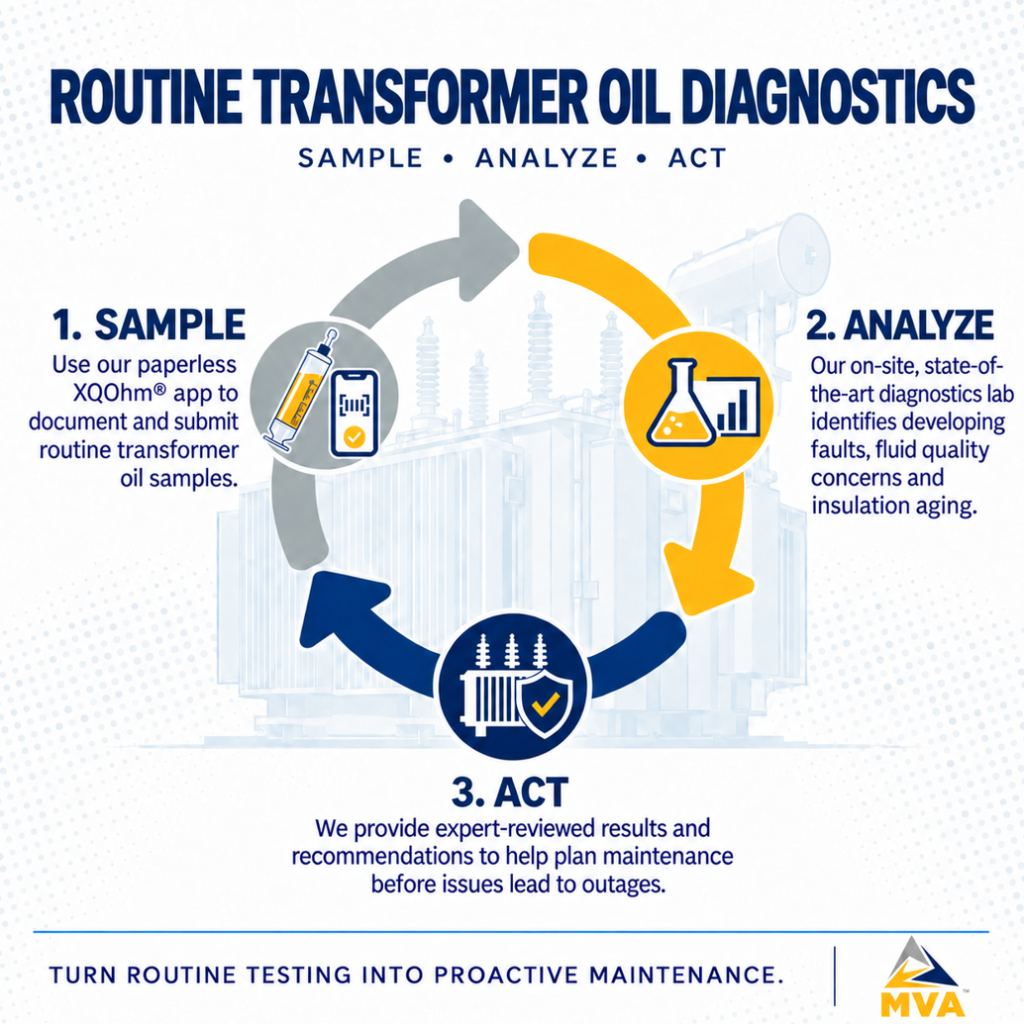
MVA’s patented XQOhm® paperless transformer oil sampling platform helps technicians manage this process in the field. Users can scan barcodes, capture photographs, record sample information, and submit data electronically, saving time while eliminating manual data-entry errors.
Laboratory data is most useful when it leads to a clear next step. Results should be reviewed in context rather than evaluated as isolated numbers.
Depending on the findings, recommendations may include:
Some abnormal results require immediate attention, while others should be monitored for continued change. Expert interpretation helps maintenance teams distinguish between the two.
Routine transformer oil testing provides a practical and cost-effective way to monitor condition, identify developing concerns, and support informed maintenance planning. A consistent program also creates the historical data needed to recognize meaningful changes throughout a transformer’s service life.
MVA provides transformer oil analysis, expert interpretation, condition-based recommendations, and transformer field services when further investigation or corrective work is required. From transformer oil sampling and laboratory diagnostics to on-site testing and repairs, one team can help identify issues, diagnose problems, and reduce the risk of unplanned outages.